When Kiera Davidson was diagnosed with Sjögren’s disease in May 2024, she was just 17 years old — a high school senior about to graduate and preparing to begin college. Like many people living with chronic illness, Kiera’s journey has included not only physical challenges but also mental, emotional, and social challenges because of Sjögren’s. Now, as a graphic design student at the University of Florida, Kiera uses art to process her feelings about Sjogren’s, share her story with others, and lay a foundation to rebuild connections she thought she’d lost.

Searching For Answers
Kiera first started noticing fatigue as a high school student, as the COVID-19 public health emergency was beginning to wind down. At first, she brushed it off as a side effect of being too busy — juggling classes, extracurricular activities, and time with friends. She thought, “Coming out of quarantine times is just making me a little sleepy.”
But over time, she began experiencing more symptoms, like body aches and brain fog. Eventually, they became impossible to ignore. Her exhaustion and aches were persistent, and the brain fog made it hard to concentrate. She recalls thinking, “I’m really struggling in school, and it’s starting to show in my grades.”
Finally, Kiera and her family decided to visit their primary care doctor to look for answers.
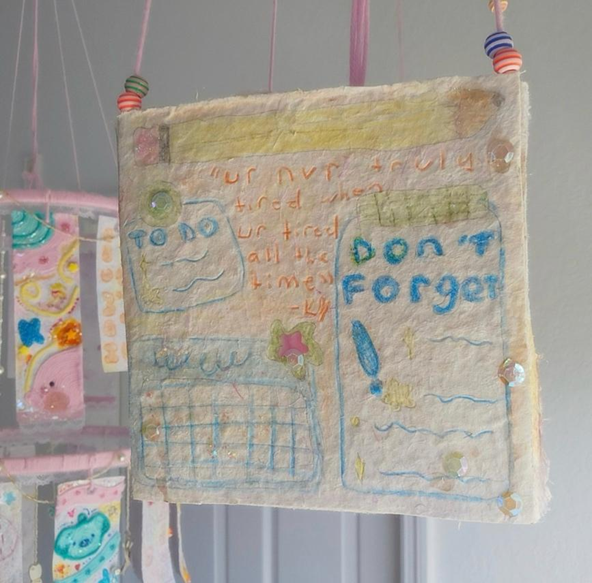
A paper lantern from Kiera’s project, “The Cutest Crashout in History.” The words read, “ur nvr truly tired when ur tired all the time,” with a drawing of a pencil, a to-do list, reminders, and a calendar.
The (Long) Road to Sjögren’s Diagnosis
Kiera’s first appointments with her primary care doctor were discouraging. Her doctor suggested that her symptoms might just be “teen fatigue” — a result of stress, growth, and lack of sleep. Then, her doctor considered whether depression might be the cause. But Kiera could tell that her symptoms had a physical cause. “After doing a sport for so long, I can kind of feel when it’s more mental or more physical. I definitely felt that it was more of a physical issue,” she says.
“It was really frustrating, and I lacked a support system,” Kiera says. “I have a hard time communicating how I was feeling, but I was definitely frustrated that I wasn’t being taken seriously.”
Eventually, her doctor ordered blood work, thyroid testing, and even a pregnancy test. When Kiera reported feeling dizzy and almost fainting while holding her arms over her head in the shower, she was referred to a rheumatologist.
That referral changed everything. The rheumatologist carefully reviewed Kiera’s symptoms and decided to test for Sjögren’s — which is less common among teenagers but matched her symptoms. After another series of tests, including a lip biopsy and eye exam, Kiera finally had an answer: she had Sjögren’s disease.
“I hadn’t heard about Sjögren’s,” Kiera shares. “I was like, this sounds kind of strange, but I was excited that I was getting closer to fixing the problem. I felt really hopeful after finding out that there could be something that we could mediate or fix.”
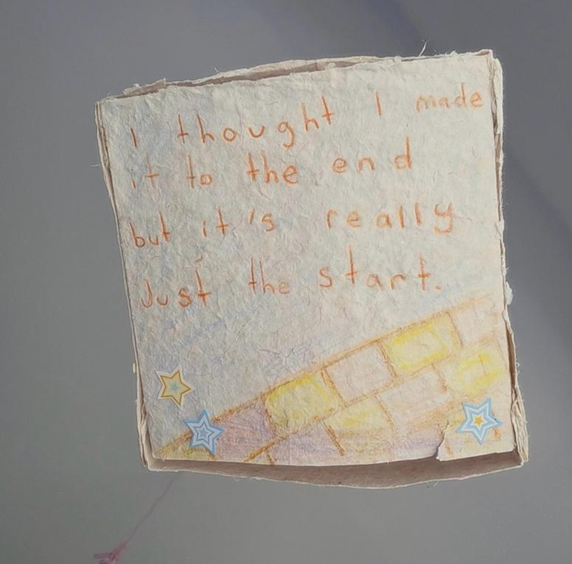
A paper lantern from Kiera’s project, “The Cutest Crashout in History.” The words read, “I thought I made it to the end but it’s really just the start.”
Kiera’s Life with Sjögren’s Disease
With a diagnosis in hand, Kiera began exploring her treatment options and started medicine to help manage her condition. Over time, she began to feel a little better — though she quickly realized that managing Sjögren’s is an ongoing process.
“I definitely feel better with the medications I’m on, but we’re still doing a lot of trial and error,” she explains.
Kiera’s also begun working through the emotional and social aspects of living with a chronic illness. For years, she had trouble explaining how she was feeling to her friends and peers. Her diagnosis brought relief but also introduced new challenges in her relationships. “Even though I did get physically better, it felt like my reaction to it got worse — like other people were able to see it after I got diagnosed,” she recalls.
For example, Kiera has had a hard time making new connections in college because of her Sjögren’s symptoms. “Everyone’s out making friends, going to clubs, and doing projects with each other, and I just can’t. But I did make a few friends through art class,” she says.
While communicating with people directly about Sjögren’s remains a challenge, Kiera’s found a new way to share her experience: through her art.
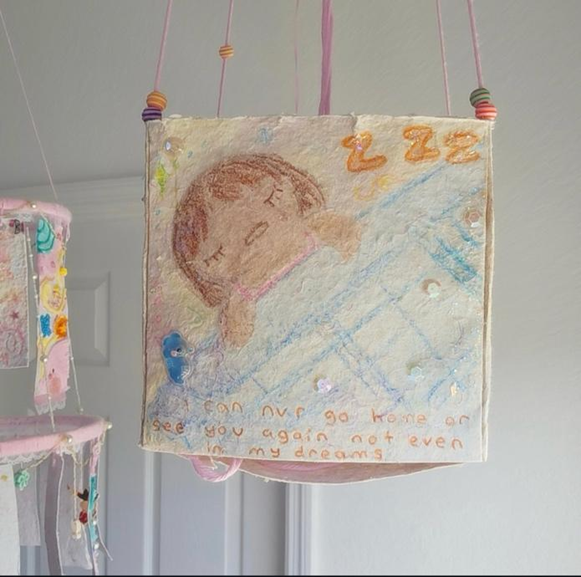
A paper lantern from Kiera’s project, “The Cutest Crashout in History.” The words read, “I can nvr go home or see you again not even in my dreams,” with a drawing of a girl in bed.
The Cutest Crashout in History
During a workshop related to her graphic design studies, Kiera created a series of paper lanterns for a project she called The Cutest Crashout in History.
Kiera dedicated the project “with love and apology to all the people who have been special to [her].” She says the sentiment’s rooted in her feelings toward the people she lost touch with over the course of her Sjögren’s journey: “All these people — I didn’t stop talking to them because I wanted to. I love talking to them. I love going out with them. Just I cannot go out because I’m really tired. And I tried to explain, but it felt like people just weren’t understanding. And it’s not their fault, because it is kind of hard to understand.”
In creating the art for this project, Kiera discovered an approach to communicating her story in a way she wasn’t able to do before.
The lanterns are inspired by her struggles during high school — especially the disconnect between how she looked on the outside and how she felt on the inside, as well as her desire to connect with others.
Kiera describes her work’s aesthetic as “cutesy,” incorporating fun colors, glitter, and eye-catching beads. “I feel like using cuteness has been my survival strategy,” she shares.
The lanterns’ panels depict different aspects of Kiera’s Sjögren’s disease — like brain fog, fatigue, and the social isolation caused by her symptoms.
Her classmates were immediately drawn to the project. “Everyone was connected to the fact that it was cute, and it gave me an opportunity to talk about my situation,” Kiera says. Through a design critique, her peers were also able to make suggestions — one that stuck with Kiera was an idea to continue to add new layers and panels to the lanterns over time. “If I keep adding more memories every year, it’ll just get bigger and bigger, and I’ll have a visual diary of everything I’ve ever done,” Kiera recalls. “I thought that was a really cool idea.”
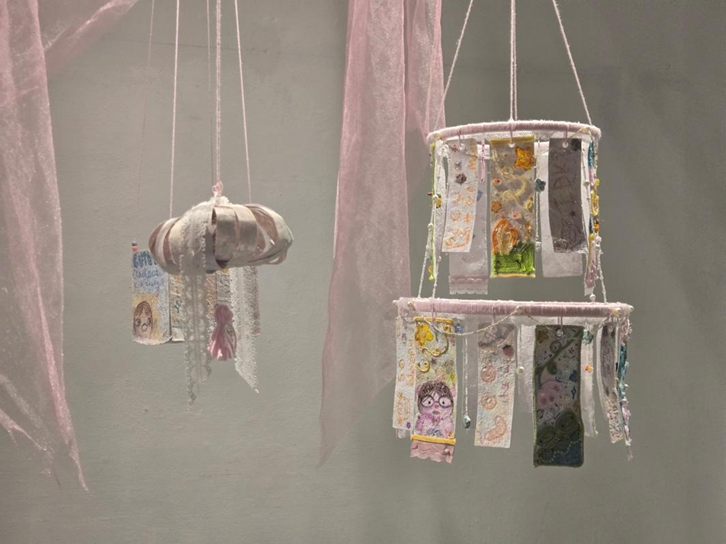
Paper lanterns from Kiera’s project, “The Cutest Crashout in History.”
Kiera hopes that if she’s still working on the project 5 years from now, her lanterns will reflect new and renewed relationships. “I hope in 5 years I’ll be making panels with people or about people that I’m still in contact with,” she shares.
“I love creating art the same way I love my friends,” Kiera says. “This project has really been a labor of love.”
Finding Hope Through Artwork
As Kiera continues to learn how to navigate life with Sjögren’s disease, she’s come to accept that there isn’t a “finish line” when it comes to managing Sjögren’s. And while the physical symptoms are tough, what she finds navigating the social side of the disease even harder. “It’s just the social part of it I did not see coming,” she says. “It’s something a little bit harder that you need to continually work through.”
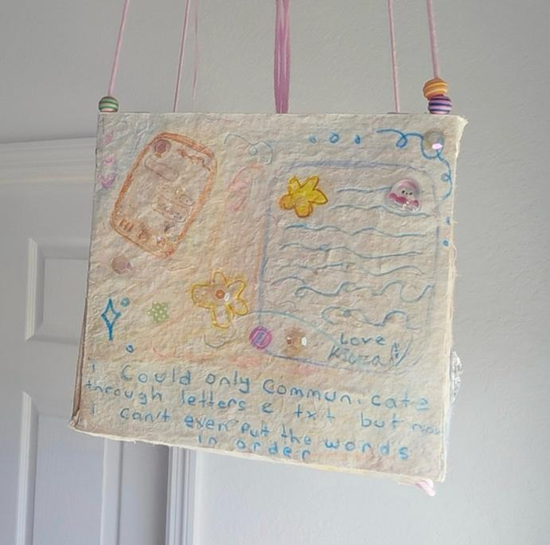
A paper lantern from Kiera’s project, “The Cutest Crashout in History.” The words read, “I could only communicate through letters & text but now I can’t even put the words in order.” The lantern includes drawings of text messages and a letter.
Kiera’s artwork helps her to tell her story on her own terms while building connections with other people. She also uses her art as a way to cope with Sjögren’s and document her journey. She hopes that, by sharing her art, like on social media, she’ll reach other young people facing chronic illness who might relate to her experiences.

Pictured: Kiera Davidson
The Sjögren’s Foundation: Sharing the Stories of People with Sjögren’s
Every person’s journey with Sjögren’s is different. By sharing Kiera’s story, the Sjögren’s Foundation hopes to remind patients — especially young patients — that they are not alone.
Kiera’s story speaks to the multifaceted nature of Sjögren’s disease. Its impact goes beyond the body, and can affect patients’ mental, emotional, and social health, too. Kiera’s courage, resilience, and creativity show that there are many ways to cope, heal, and tell the story of what it’s like to live with Sjögren’s. Her art gives others insight into the invisible challenges of Sjogren’s while also celebrating beauty, humor, and hope.
When Kiera Davidson was diagnosed with Sjögren’s disease in May 2024, she was just 17 years old — a high school senior about to graduate and preparing to begin college. Like many people living with chronic illness, Kiera’s journey has included not only physical challenges but also mental, emotional, and social challenges because of Sjögren’s. Now, as a graphic design student at the University of Florida, Kiera uses art to process her feelings about Sjogren’s, share her story with others, and lay a foundation to rebuild connections she thought she’d lost.
Searching For Answers
Kiera first started noticing fatigue as a high school student, as the COVID-19 public health emergency was beginning to wind down. At first, she brushed it off as a side effect of being too busy — juggling classes, extracurricular activities, and time with friends. She thought, “Coming out of quarantine times is just making me a little sleepy.”
But over time, she began experiencing more symptoms, like body aches and brain fog. Eventually, they became impossible to ignore. Her exhaustion and aches were persistent, and the brain fog made it hard to concentrate. She recalls thinking, “I’m really struggling in school, and it’s starting to show in my grades.”
Finally, Kiera and her family decided to visit their primary care doctor to look for answers.
A paper lantern from Kiera’s project, “The Cutest Crashout in History.” The words read, “ur nvr truly tired when ur tired all the time,” with a drawing of a pencil, a to-do list, reminders, and a calendar.
The (Long) Road to Sjögren’s Diagnosis
Kiera’s first appointments with her primary care doctor were discouraging. Her doctor suggested that her symptoms might just be “teen fatigue” — a result of stress, growth, and lack of sleep. Then, her doctor considered whether depression might be the cause. But Kiera could tell that her symptoms had a physical cause. “After doing a sport for so long, I can kind of feel when it’s more mental or more physical. I definitely felt that it was more of a physical issue,” she says.
“It was really frustrating, and I lacked a support system,” Kiera says. “I have a hard time communicating how I was feeling, but I was definitely frustrated that I wasn’t being taken seriously.”
Eventually, her doctor ordered blood work, thyroid testing, and even a pregnancy test. When Kiera reported feeling dizzy and almost fainting while holding her arms over her head in the shower, she was referred to a rheumatologist.
That referral changed everything. The rheumatologist carefully reviewed Kiera’s symptoms and decided to test for Sjögren’s — which is less common among teenagers but matched her symptoms. After another series of tests, including a lip biopsy and eye exam, Kiera finally had an answer: she had Sjögren’s disease.
“I hadn’t heard about Sjögren’s,” Kiera shares. “I was like, this sounds kind of strange, but I was excited that I was getting closer to fixing the problem. I felt really hopeful after finding out that there could be something that we could mediate or fix.”
A paper lantern from Kiera’s project, “The Cutest Crashout in History.” The words read, “I thought I made it to the end but it’s really just the start.”
Kiera’s Life with Sjögren’s Disease
With a diagnosis in hand, Kiera began exploring her treatment options and started medicine to help manage her condition. Over time, she began to feel a little better — though she quickly realized that managing Sjögren’s is an ongoing process.
“I definitely feel better with the medications I’m on, but we’re still doing a lot of trial and error,” she explains.
Kiera’s also begun working through the emotional and social aspects of living with a chronic illness. For years, she had trouble explaining how she was feeling to her friends and peers. Her diagnosis brought relief but also introduced new challenges in her relationships. “Even though I did get physically better, it felt like my reaction to it got worse — like other people were able to see it after I got diagnosed,” she recalls.
For example, Kiera has had a hard time making new connections in college because of her Sjögren’s symptoms. “Everyone’s out making friends, going to clubs, and doing projects with each other, and I just can’t. But I did make a few friends through art class,” she says.
While communicating with people directly about Sjögren’s remains a challenge, Kiera’s found a new way to share her experience: through her art.
A paper lantern from Kiera’s project, “The Cutest Crashout in History.” The words read, “I can nvr go home or see you again not even in my dreams,” with a drawing of a girl in bed.
The Cutest Crashout in History
During a workshop related to her graphic design studies, Kiera created a series of paper lanterns for a project she called The Cutest Crashout in History.
Kiera dedicated the project “with love and apology to all the people who have been special to [her].” She says the sentiment’s rooted in her feelings toward the people she lost touch with over the course of her Sjögren’s journey: “All these people — I didn’t stop talking to them because I wanted to. I love talking to them. I love going out with them. Just I cannot go out because I’m really tired. And I tried to explain, but it felt like people just weren’t understanding. And it’s not their fault, because it is kind of hard to understand.”
In creating the art for this project, Kiera discovered an approach to communicating her story in a way she wasn’t able to do before.
The lanterns are inspired by her struggles during high school — especially the disconnect between how she looked on the outside and how she felt on the inside, as well as her desire to connect with others.
Kiera describes her work’s aesthetic as “cutesy,” incorporating fun colors, glitter, and eye-catching beads. “I feel like using cuteness has been my survival strategy,” she shares.
The lanterns’ panels depict different aspects of Kiera’s Sjögren’s disease — like brain fog, fatigue, and the social isolation caused by her symptoms.
Her classmates were immediately drawn to the project. “Everyone was connected to the fact that it was cute, and it gave me an opportunity to talk about my situation,” Kiera says. Through a design critique, her peers were also able to make suggestions — one that stuck with Kiera was an idea to continue to add new layers and panels to the lanterns over time. “If I keep adding more memories every year, it’ll just get bigger and bigger, and I’ll have a visual diary of everything I’ve ever done,” Kiera recalls. “I thought that was a really cool idea.”
Paper lanterns from Kiera’s project, “The Cutest Crashout in History.”
Kiera hopes that if she’s still working on the project 5 years from now, her lanterns will reflect new and renewed relationships. “I hope in 5 years I’ll be making panels with people or about people that I’m still in contact with,” she shares.
“I love creating art the same way I love my friends,” Kiera says. “This project has really been a labor of love.”
Finding Hope Through Artwork
As Kiera continues to learn how to navigate life with Sjögren’s disease, she’s come to accept that there isn’t a “finish line” when it comes to managing Sjögren’s. And while the physical symptoms are tough, what she finds navigating the social side of the disease even harder. “It’s just the social part of it I did not see coming,” she says. “It’s something a little bit harder that you need to continually work through.”
A paper lantern from Kiera’s project, “The Cutest Crashout in History.” The words read, “I could only communicate through letters & text but now I can’t even put the words in order.” The lantern includes drawings of text messages and a letter.
Kiera’s artwork helps her to tell her story on her own terms while building connections with other people. She also uses her art as a way to cope with Sjögren’s and document her journey. She hopes that, by sharing her art, like on social media, she’ll reach other young people facing chronic illness who might relate to her experiences.
Pictured: Kiera Davidson
The Sjögren’s Foundation: Sharing the Stories of People with Sjögren’s
Every person’s journey with Sjögren’s is different. By sharing Kiera’s story, the Sjögren’s Foundation hopes to remind patients — especially young patients — that they are not alone.
Kiera’s story speaks to the multifaceted nature of Sjögren’s disease. Its impact goes beyond the body, and can affect patients’ mental, emotional, and social health, too. Kiera’s courage, resilience, and creativity show that there are many ways to cope, heal, and tell the story of what it’s like to live with Sjögren’s. Her art gives others insight into the invisible challenges of Sjogren’s while also celebrating beauty, humor, and hope.